Kutchina Chimney Buying Guide: Suction Power, Size & Features Explained (2026)
Ammon Marketing
Authorized Kutchina Dealer · Ranchi
18 Jun 2026
~ read
TL;DR
- Indian cooking (tadka, deep frying, heavy spices) needs a chimney with minimum 1300 m³/hr suction — do not buy less
- Filterless auto-clean chimneys are worth the higher price — no monthly filter washing, no suction loss over time
- Match chimney width to your hob: 60cm for 2-burner, 75–90cm for 3–4 burner hobs
- Kutchina's 3rd Gen i-Autoclean is India's only domestic auto-clean chimney system — designed for Indian cooking oil volumes
Quick Answer: For an Indian kitchen with regular cooking — daily tadka, stir-frying, or deep frying — you need a chimney with at least 1300 m³/hr suction capacity. Kutchina filterless chimneys with i-Autoclean technology maintain full suction without filter clogging. Choose 60cm for 2-burner hobs, 75–90cm for 3–4 burner cooktops.
You spend ₹15,000–₹35,000 on a chimney. Install it. Within 18 months, the suction has dropped by half, the filters are clogged with cooking oil, and your kitchen walls are back to smelling like the last five curries.
This is what happens when a chimney is chosen for price or looks instead of being matched to how you actually cook. This guide fixes that — suction requirements, filter vs filterless, sizing, and what Kutchina's auto-clean technology actually does differently.
Why Suction Power Is the Most Important Spec
Suction power (measured in m³/hr — cubic metres per hour) tells you how much air the chimney pulls through every hour. Higher number = more fumes, smoke, and oil particles removed before they reach your cabinets and ceiling.
The catch: most chimney spec sheets list maximum suction on day one with a clean chimney. Real-world performance after 6–12 months of Indian cooking is significantly lower — especially with filter-based chimneys where oil accumulates and blocks airflow. Indian kitchens generate far more particulate matter than the European kitchens these specs were originally designed around.
| Cooking Style | Minimum Suction | Recommended |
|---|---|---|
| Light cooking (salads, sandwiches, reheating) | 600–800 m³/hr | 900 m³/hr |
| Moderate Indian cooking (roti, dal, sabzi daily) | 900–1100 m³/hr | 1200 m³/hr |
| Heavy Indian cooking (tadka, frying, biryani) | 1200–1400 m³/hr | 1400–1500 m³/hr |
| Open/island kitchen or 4-burner hob | 1400–1600 m³/hr | 1500 m³/hr+ |
Filter vs Filterless: The Decision That Affects 10 Years of Your Kitchen
Filter-Based Chimneys
Use mesh or baffle filters to trap oil particles before they reach the motor. Oil collects on the filter. After 4–8 weeks of regular Indian cooking, the filter clogs. Suction drops noticeably. You remove the filter, soak it in hot water and detergent, dry it, and reinstall. Monthly, for 10 years.
Even when cleaned correctly, filters never fully recover their original airflow. By year 3, a well-maintained filter chimney typically operates at 60–70% of its rated suction.
Filterless Auto-Clean Chimneys (Kutchina i-Autoclean)
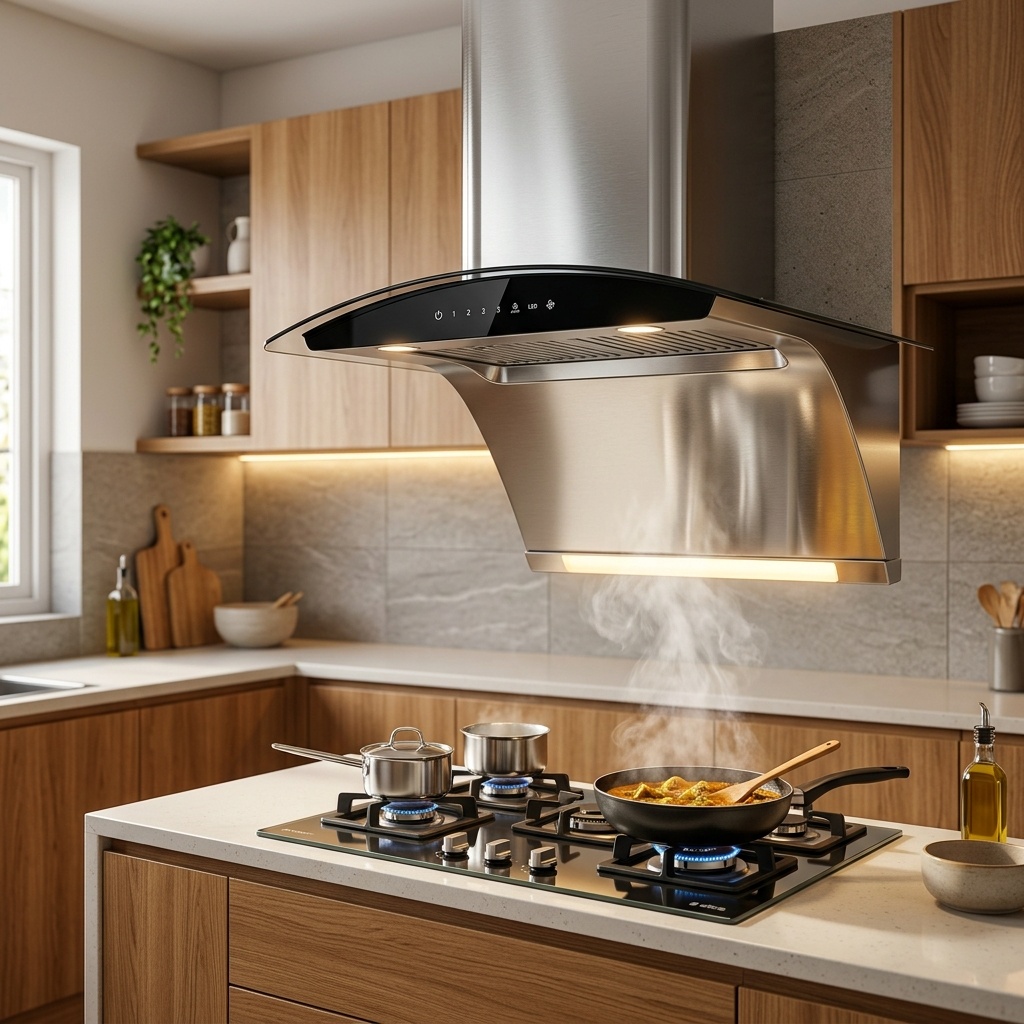
Instead of trapping oil in a filter, filterless chimneys use centrifugal force to spin oil particles out of the airstream. The oil collects in a removable oil collector cup at the chimney base — not in a filter blocking airflow. Suction stays consistent because there is no filter to clog. Empty the oil cup every 6–8 weeks (takes 2 minutes).
Kutchina's 3rd Generation i-Autoclean system is developed specifically for Indian cooking volumes — the centrifuge is calibrated for the density of mustard oil, ghee, and coconut oil used in Indian kitchens, not the lighter cooking fats in European appliances.
| Factor | Filter Chimney | Filterless Auto-Clean (Kutchina) |
|---|---|---|
| Initial cost | ₹8,000–₹20,000 | ₹15,000–₹45,000 |
| Maintenance effort | Monthly filter wash (30–60 min) | Empty oil cup every 6–8 weeks (2 min) |
| Suction over time | Degrades as filter clogs | Consistent — no filter to block |
| Noise over time | Increases as filter clogs | Stays consistent |
| 10-year maintenance cost | ₹5,000–₹15,000 (filter replacements) | ₹1,000–₹2,000 (basic service) |
| Best for | Very light cooking, rental flats | Regular Indian cooking, all homes |
Chimney Width: Match Your Chimney to Your Hob
The chimney width must equal or exceed your cooking hob width. A chimney narrower than the hob leaves the outer burners uncovered — fumes escape sideways, defeating the purpose of the appliance.
- 60cm chimney: For 2-burner hobs. Minimum for any standard kitchen.
- 75cm chimney: For 3-burner hobs, or 60cm hobs in open kitchens where side-draft matters.
- 90cm chimney: For 4-burner hobs, island kitchens, or any kitchen where the cooking zone is wide or central.
Ducted vs Ductless Installation in Ranchi
Ducted (always recommended for Ranchi homes): The chimney expels kitchen air directly outside through a duct in the wall or ceiling. Removes fumes, humidity, and cooking odours entirely. All Kutchina chimneys through Ammon Marketing are configured for ducted installation, with duct routing planned during the free site visit.
Ductless (recirculating): Pulls air through a charcoal filter and returns cleaned air to the kitchen. No wall penetration needed — useful for rental flats. But ductless systems are significantly less effective at removing humidity and heat. Most Ranchi homes built after 2010 can accommodate ducted installation without structural changes.
Features Worth Paying For — and Features That Aren't
- Worth paying for: Auto-clean / filterless technology, wave or touch sensor controls (easier to clean than button panels), bright LED lighting that covers the full hob area, thermal auto-off.
- Not worth the premium: Bluetooth connectivity, colour-changing LEDs, suction speeds above 1500 m³/hr for regular kitchens (overkill for most Ranchi homes).
Frequently Asked Questions
How much suction power do I need for a chimney in Ranchi?
For regular Indian cooking — daily tadka, frying, biryani — you need at least 1300 m³/hr. For open kitchens or 4-burner hobs, choose 1400–1500 m³/hr. Anything under 1000 m³/hr is insufficient for Indian cooking and will result in oily cabinets and stained ceilings within 2 years.
What is Kutchina i-Autoclean technology?
Kutchina's 3rd Generation i-Autoclean uses centrifugal force to spin oil particles out of kitchen air before they reach the motor. Oil collects in a removable cup instead of clogging a filter. This maintains consistent suction power indefinitely — unlike filter chimneys where suction degrades as oil accumulates on the mesh.
What chimney size is right for my Ranchi kitchen?
Match chimney width to your cooking hob. 60cm for 2-burner hobs. 75cm for 3-burner hobs. 90cm for 4-burner or island kitchens. A chimney narrower than the hob leaves outer burners uncovered, significantly reducing effectiveness.
Is filterless chimney better than filter chimney for Indian cooking?
Yes, for Indian cooking. Filter chimneys require monthly cleaning and lose suction as filters clog with cooking oil. Filterless chimneys maintain consistent suction and require only a quick oil cup emptying every 6–8 weeks. The higher cost (₹15,000–₹45,000 vs ₹8,000–₹20,000) pays back within 3 years of saved maintenance.
Can I install a chimney without a duct in Ranchi?
Yes — ductless (recirculating) chimneys use charcoal filters to clean air and return it to the kitchen. They reduce cooking odours but cannot remove humidity or heat. For any kitchen where duct installation is possible, ducted is strongly preferred. Ammon Marketing assesses the best duct route during the free site visit.
What is the price of Kutchina chimney in Ranchi?
Kutchina chimneys through Ammon Marketing in Ranchi range from ₹12,000 to ₹45,000. Entry-level filter-based models: ₹12,000–₹18,000. Mid-range auto-clean with 1300 m³/hr: ₹18,000–₹28,000. Premium i-Autoclean models with 1500 m³/hr: ₹28,000–₹45,000. All come with warranty and after-sales service in Ranchi.
How often does a chimney need servicing in Ranchi?
Filterless Kutchina chimneys need the oil collector cup emptied every 6–8 weeks during regular use. A professional motor check and deep clean is recommended once a year — typically covered under an AMC. Filter-based chimneys need monthly filter cleaning plus an annual professional service visit.
What is the difference between Kutchina and other chimney brands?
Kutchina is India's only manufacturer of auto-clean chimneys with centrifugal oil separation technology designed for Indian cooking volumes. Most competing brands use baffle or mesh filters imported from Chinese suppliers. Kutchina's service network covers all of Jharkhand, with Ammon Marketing handling warranty claims and service in Ranchi.
Key Takeaways
- 1300–1500 m³/hr is the right suction range for regular Indian cooking in Ranchi
- Filterless auto-clean chimneys maintain consistent suction without monthly filter washing
- Chimney width must equal or exceed your hob width — 60cm for 2-burner, 75–90cm for 3–4 burner
- Ducted installation removes fumes from the kitchen entirely — far more effective than ductless recirculating
- Kutchina i-Autoclean is the only Indian-made auto-clean centrifugal system designed for Indian cooking oil volumes
See These Ideas in Real Homes

Free · No Obligation
Talk to Our Design Experts
Ammon Marketing Editorial Team
Authorized Kutchina Dealer · Ranchi · Est. 2014
Our guides are written by Ranchi-based kitchen designers and appliance experts with 10+ years of on-the-ground experience. Every recommendation is based on real projects completed in Jharkhand homes — not generic advice from outside the region.