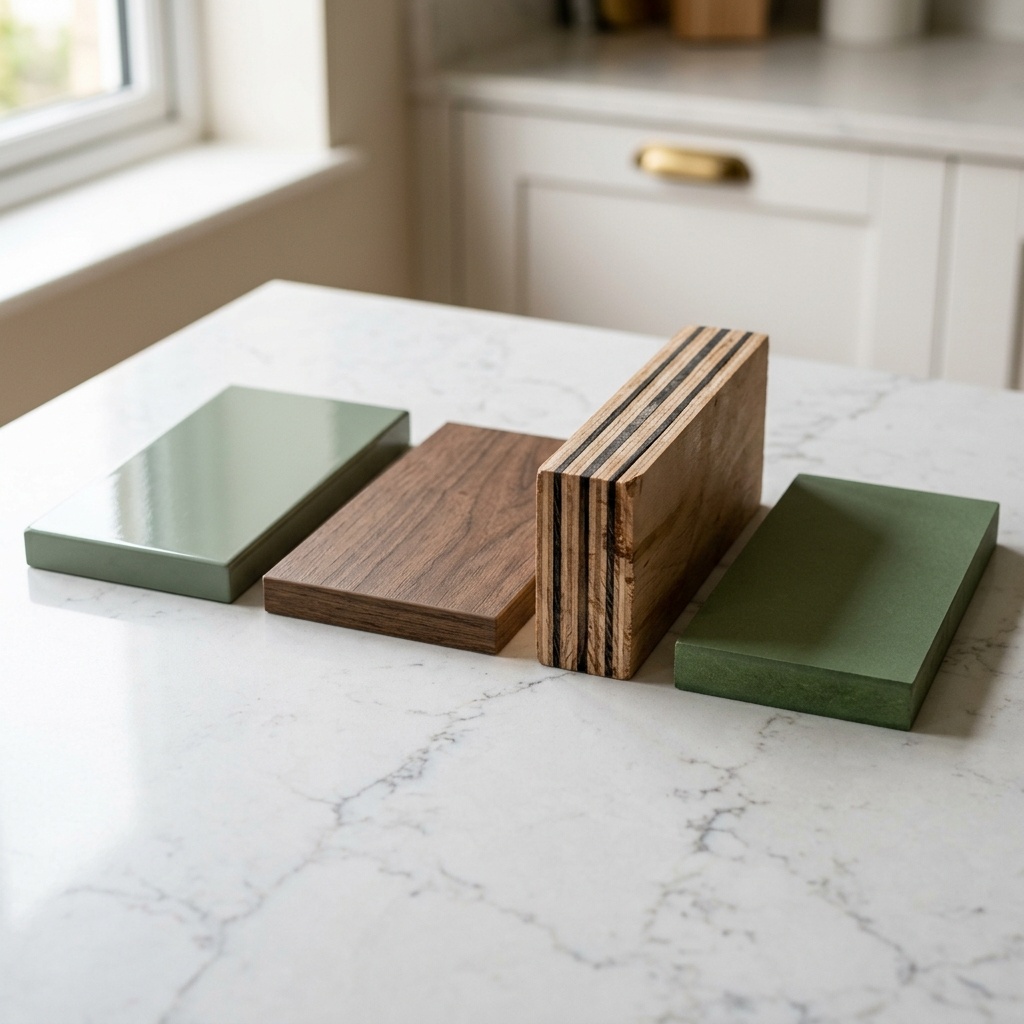
POP vs Gypsum False Ceiling in Ranchi: Cost, Comparison & Best Designs (2026)
Ammon Marketing
Authorized Kutchina Dealer · Ranchi
26 Apr 2026
~ read
TL;DR
- Gypsum board false ceilings cost ₹65–₹95/sq ft in Ranchi — faster to install, cleaner finish, better for LED cove lighting
- POP false ceilings cost ₹55–₹80/sq ft — better for curved and ornate designs but slower and more dependent on craftsman skill
- For most Ranchi homes in 2026, gypsum is the right choice — faster installation, no cracking over time, better moisture resistance
- A false ceiling with LED cove lighting adds ₹12,000–₹25,000 to a standard living room — and transforms the space
Quick Answer:For most Ranchi homes, gypsum board false ceiling is the better choice. It costs ₹65–₹95/sq ft, installs in 2–3 days per room, creates seamless clean lines, handles LED cove lighting perfectly, and doesn't crack over time. POP is better for highly curved or ornate designs — but requires skilled manual application and takes longer.
Every Ranchi homeowner planning a living room renovation eventually asks this question: POP false ceiling or gypsum board? Both can look excellent. Both hide electrical wiring and enable cove lighting. The decision comes down to your design goals, timeline, and budget.
This guide gives you the honest comparison — not just the feature list, but what each looks like after 5 years in a Ranchi home, how they hold up through the monsoon season, and which actually costs more in the long run.
What Is a False Ceiling and Why Install One?
A false ceiling (also called a dropped ceiling or suspended ceiling) is a secondary ceiling installed below the main RCC slab. The gap between the false ceiling and the main slab hides: electrical wiring, AC ducts and vents, water pipes, and the LED strip or spot lighting infrastructure.
The functional benefits: concealed wiring, integrated lighting, thermal insulation (the air gap between ceilings reduces heat transfer), and acoustic improvement. The aesthetic benefit: it transforms a plain concrete ceiling into a designed architectural element.
POP False Ceiling: What It Is and How It Works
Plaster of Paris (POP) false ceilings are created by mixing gypsum plaster with water and applying it manually over a wire mesh or metal framework. The plasterer shapes the design by hand — curves, layered borders, ornate central medallions, and custom profiles are all possible with POP because the material is workable before it sets.
The limitation: POP is entirely dependent on the skill of the plasterer. A less experienced craftsman produces uneven surfaces, poor joints, and cracks that appear within 2–3 years. POP also takes longer — multiple layers need to dry between application — and is slightly more susceptible to moisture damage in humid conditions like Ranchi's monsoon.
Gypsum Board False Ceiling: Factory Precision for Clean Lines
Gypsum board false ceilings use factory-made boards (typically 12.5mm thick, in 1200×2400mm sheets) fixed to a metal frame (usually a galvanized steel grid of perimeter channels and intermediate joists). The boards are screwed to the frame, joints are taped and filled, and the surface is finished with a skim coat before painting.
The advantage: Gypsum board produces consistent, dimensionally accurate results regardless of craftsman skill — because the material is factory-made and the installation follows a defined system. Joints filled with joint compound and taped correctly are invisible after painting. Moisture-resistant gypsum boards (green board) are available for kitchens and bathrooms.
POP vs Gypsum False Ceiling: Complete Comparison for Ranchi
| Factor | POP Ceiling | Gypsum Board Ceiling | Winner |
|---|---|---|---|
| Cost in Ranchi (per sq ft) | ₹55–₹80/sq ft | ₹65–₹95/sq ft | POP (marginal) |
| Installation time (per room) | 5–8 days | 2–3 days | Gypsum |
| Design flexibility | High — curves, ornate profiles, layers | Medium — mainly straight lines, gentle curves | POP |
| Surface finish quality | Depends on craftsman skill | Consistent — factory material | Gypsum |
| Cracking over time | Can crack if plaster mix incorrect | Minimal — joint compound absorbs movement | Gypsum |
| Moisture resistance | Moderate — can absorb moisture | Better — moisture-resistant boards available | Gypsum |
| LED cove lighting | Good — cove profile possible but skill-dependent | Excellent — straight channels for LED strips | Gypsum |
| Repair if damaged | Difficult — matching texture is hard | Easier — boards can be cut and patched | Gypsum |
| Best suited for | Ornate, curved, traditional designs | Modern, minimalist, clean-line designs | Depends on style |
False Ceiling Designs for Ranchi Living Rooms in 2026
1. Perimeter Cove Ceiling (Most Popular)
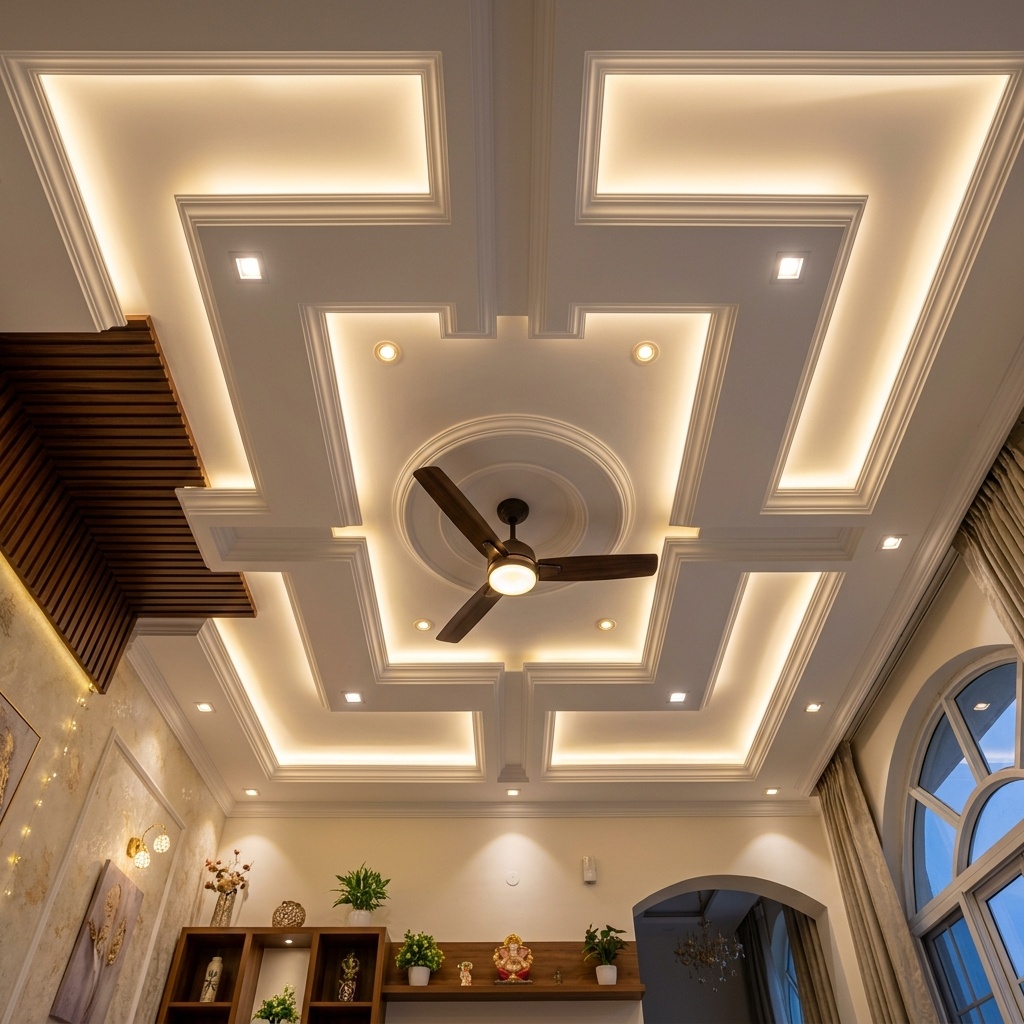
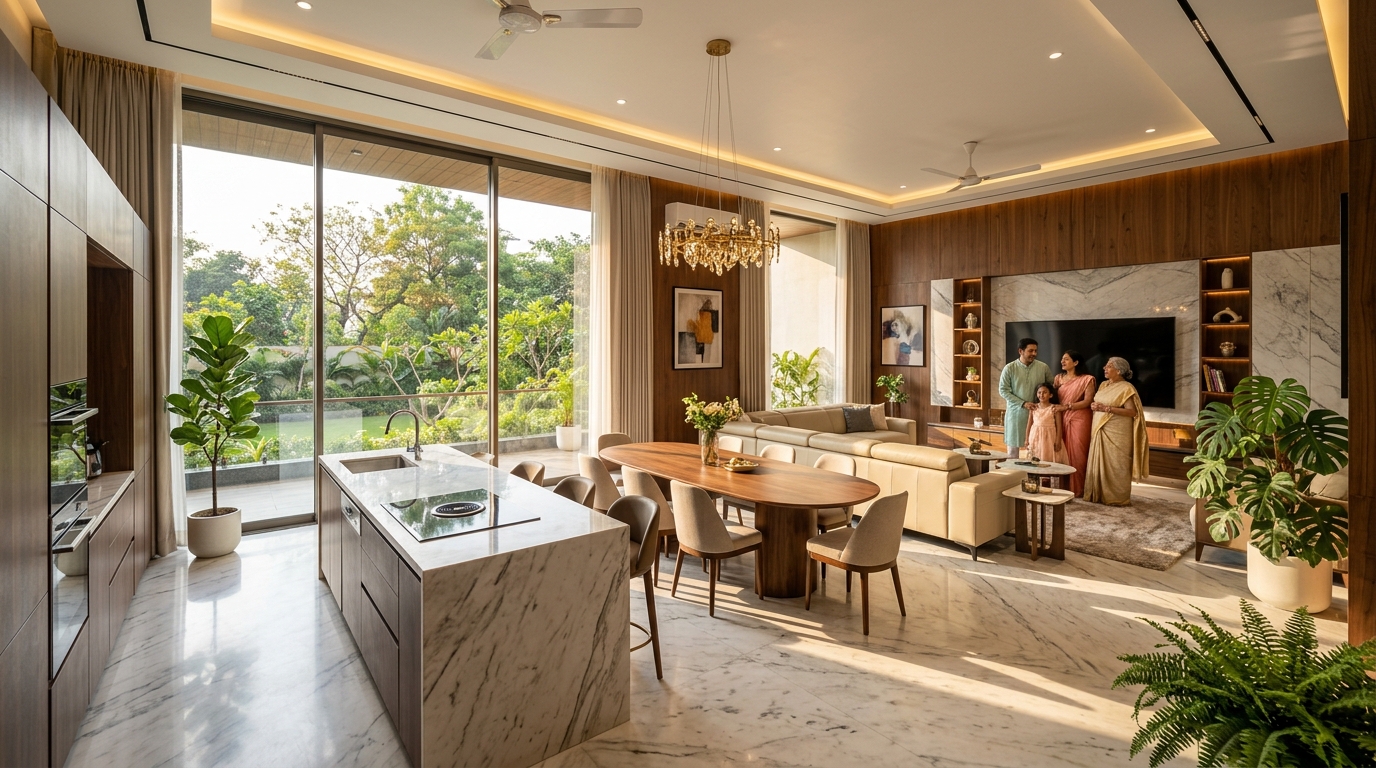
A step ceiling where the perimeter drops 8–12 inches lower than the centre, creating a recessed cove. LED strips run in the cove, projecting light upward and outward — filling the room with indirect, diffused light. Clean, modern, works with any décor. Can be done in both POP and gypsum. Cost for a standard 15×12 ft living room: ₹28,000–₹45,000 including LED strips.
2. Centre Medallion with Flat Perimeter (Traditional)
A decorative centre medallion — circular, octagonal, or square — with a chandelier drop point, surrounded by a flat perimeter. Best executed in POP because the ornate profile requires manual shaping. Works well in traditional and transitional interiors. Cost: ₹22,000–₹40,000.
3. Tray Ceiling (Recessed Centre)
The opposite of the perimeter cove — the centre of the ceiling is higher than the perimeter, creating a tray or coffered effect. The raised centre can have a different colour or material (wood panels, mirror). The perimeter carries the lighting. Best in gypsum for clean geometric lines. Cost: ₹30,000–₹55,000.
4. Grid or Coffered Ceiling
Multiple recessed panels in a grid pattern — think the ceiling of a classical library or a colonial-era bungalow, modernized. Works best in gypsum. The structured look requires precise straight lines that gypsum delivers more consistently than POP. Cost: ₹40,000–₹70,000 for a standard living room.
Ranchi climate note: False ceilings in Ranchi must account for the monsoon season (June–September) where humidity can reach 85–90%. Always use moisture-resistant gypsum boards (green board) in kitchens and rooms adjacent to bathrooms. In living rooms and bedrooms, standard gypsum is fine as long as the roof above doesn't leak — fix any roof leaks before installing a false ceiling.
Frequently Asked Questions
What is the cost of false ceiling in Ranchi per sq ft?
POP false ceiling costs ₹55–₹80 per sq ft in Ranchi, while gypsum board costs ₹65–₹95 per sq ft. For a 150 sq ft living room, POP costs ₹8,000–₹12,000 and gypsum costs ₹9,750–₹14,250 for the ceiling board and frame. Add ₹8,000–₹20,000 for LED cove lighting if included. Total for a living room: ₹18,000–₹45,000.
Which is better for Ranchi — POP or gypsum false ceiling?
For most Ranchi homes, gypsum board false ceiling is the better choice. It installs faster (2–3 days vs 5–8 for POP), produces consistent quality regardless of craftsman skill, handles LED cove lighting better, and is more moisture-resistant through Ranchi's monsoon season. POP is better only if you need highly curved or ornate custom profiles.
How long does a false ceiling take to install in Ranchi?
A gypsum board false ceiling for a standard 150 sq ft living room takes 2–3 days in Ranchi — 1 day for the metal frame, 1 day for boarding and taping, and finishing after the compound dries. POP takes 5–8 days because multiple plaster layers need to dry. Painting adds 1–2 more days after the ceiling is complete.
Can a false ceiling reduce heat in a Ranchi home during summer?
Yes, partially. The air gap between the false ceiling and the main RCC slab acts as an insulating layer, reducing direct heat transfer from the hot concrete slab above. This can reduce felt temperature by 2–4°C. The effect is more noticeable in top-floor apartments that receive direct sun on the roof. A false ceiling doesn't replace air conditioning but reduces the load on AC units.
What LED colour temperature is best for false ceiling cove lighting?
Warm white (2700K–3000K) LED strips are best for living room and bedroom cove lighting — they create a cosy, relaxed atmosphere and complement warm interior colours. Cool white (4000K–5000K) is better for kitchen and bathroom ceiling lighting where task visibility matters more than ambience. Avoid blue-white (6000K+) in any residential space — it feels clinical.
Can I install a false ceiling in a Ranchi apartment without landlord permission?
In a rented apartment, false ceilings require landlord permission — they involve drilling into the RCC slab for anchor points and are not easily reversible. In your own apartment in a Ranchi housing society, a false ceiling is considered interior decoration and typically doesn't require society approval unless it involves changes to the structural slab or shared services.
How do I repair a cracked POP false ceiling in Ranchi?
Small hairline cracks in POP ceilings are common after 3–5 years and can be filled with wall putty, sanded, and repainted. Larger cracks indicate structural movement or poor initial application — these need a contractor to cut out the damaged section and re-plaster. Gypsum board ceilings crack less frequently; when they do, a patch of joint compound and repainting is usually sufficient.
Is false ceiling necessary with a new modular kitchen or interior design?
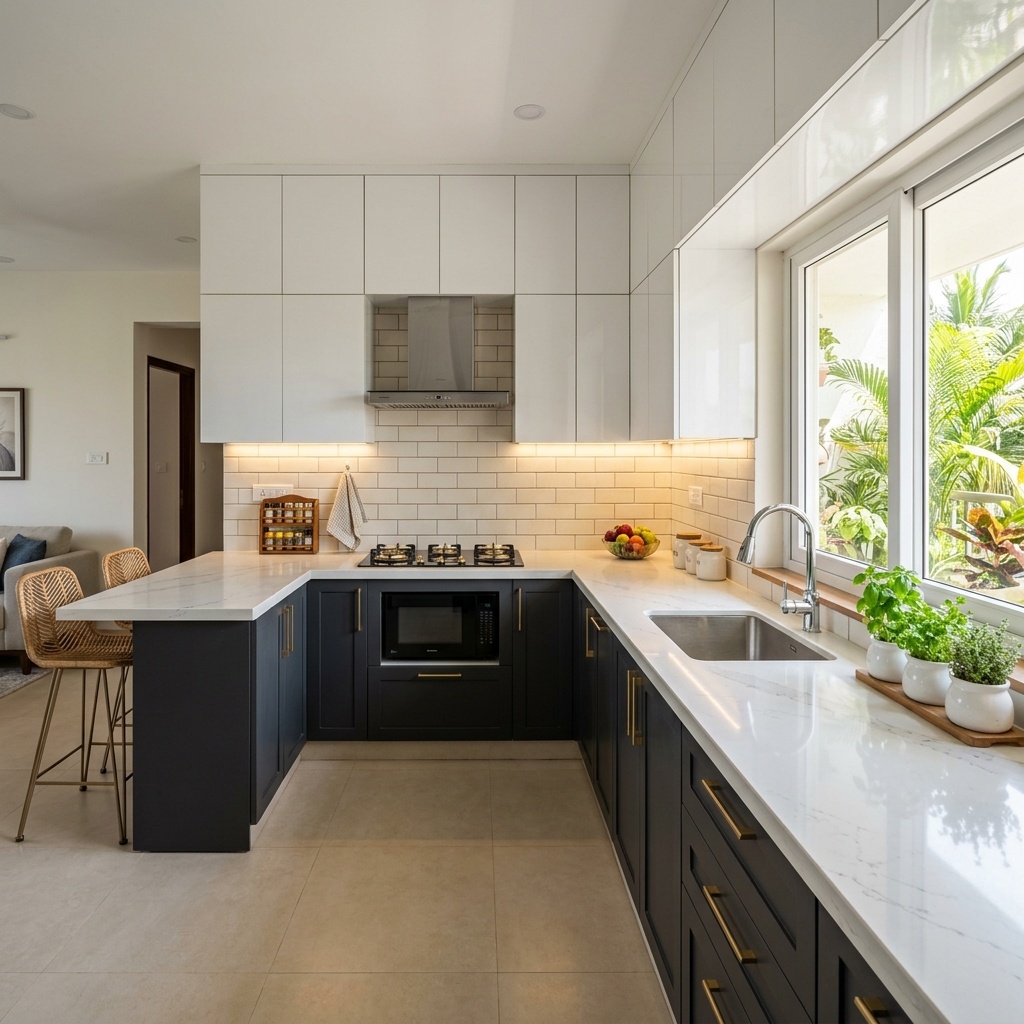
Not necessary, but highly recommended if you want concealed wiring, ambient lighting, and a finished look. In kitchens, a false ceiling allows the chimney duct to be routed through the cavity rather than exposed on the wall — a much cleaner result. In living rooms, cove lighting from a false ceiling delivers the ambient atmosphere that a bare ceiling with surface fixtures cannot.
Key Takeaways
- For most Ranchi homes, gypsum board false ceiling is the better choice — faster, more consistent quality, better moisture resistance
- POP is better only for highly curved or ornate profiles that gypsum board's straight-line construction can't achieve
- A perimeter cove ceiling with warm white LED strips is the most popular living room ceiling design in Ranchi in 2026
- Budget ₹18,000–₹45,000 for a complete false ceiling with LED cove lighting in a standard Ranchi living room
- Always use moisture-resistant gypsum boards in kitchens and wet areas — fix any roof leaks before installing any false ceiling
See These Ideas in Real Homes
Free · No Obligation
Talk to Our Design Experts
Ammon Marketing Editorial Team
Authorized Kutchina Dealer · Ranchi · Est. 2014
Our guides are written by Ranchi-based kitchen designers and appliance experts with 10+ years of on-the-ground experience. Every recommendation is based on real projects completed in Jharkhand homes — not generic advice from outside the region.